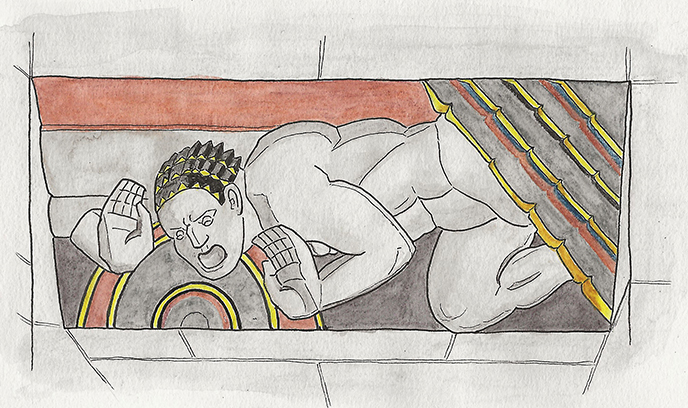
I rarely re-visit the same subject twice, but I was never really happy with the drawing I did of Paul Manship's Prometheus at Rockefeller Center I did before, so when I saw over the summer that there were seating risers in the area where the ice skating rink sits in the winter, I took the opportunity for a do-over.
If you're looking for the singer, you've come to the wrong place.
I'm a different Chris Brown.This is my house o'artwork.
Monday, October 28, 2024
Prometheus Take 2
Monday, April 24, 2023
Rockefeller Center: Léon-Victor Solon
While Lee Lawrie receives credit for the most pieces of work at Rockefeller Center, Léon-Victor Solon (1873-1957) created the coloring for more than 87 sculptures. Solon came from a family of distinguished English ceramics artists. He emigrated to the United States in 1909 and began work for tiling companies.
Classically trained in the arts, Solon was particularly fascinated by research into Greek polychromy, the painting schemes originally applied to classical sculpture and architecture. Solon lamented the "dull and lifeless buildings of today" and advocated increased use of color in modern architecture. "A soothing green would be suitable for localities like the Wall Street district where nerves are subject to constant excitement," he wrote. Solon had learned that the German manufacturer Keim had developed a paint that bonded to limestone, which he then used for the Wisdom, Sound and Light sculptures. On the basis of that work, Solon was hired to be the colorist for the entire center, creating color schemes for 87 pieces. So, while Lawrie is credited for 14 pieces in the complex, it could be said that it is Solon's work which is most prevalent throughout the project.
Three more pieces by Lawrie and Solon. Progress is above the 49th St. entrance. It features Columbia, a traditional female symbol of America, holding a flame of divine fire in one hand, and an olive branch, symbol of peace, in the other. She is accompanied by Pegasus, a symbol of inspiration, and an eagle, symbol of power.
Winged Mercury is an intaglio relief above the entrance at 620 Fifth Ave. It represents the wealth and vitality of the British merchant fleets.
Cornucopia of Plenty, above the entrance at 10 West 51st St., symbolizes "the plentitude that would result from well-organized international trade."
Commerce and Industry With a Caduceus, at 636 Fifth Avenue, is not a Lawrie piece. It's by Attilo Piccirilli, an Italian immigrant whose family is responsible for many of the most famous sculptures in New York City. Attilio was also the sculptor of the statue of Lincoln at the Lincoln Memorial. The male figure represents commerce, the female symbolizes industry, and the caduceus is a symbol of Mercury, god of trade.
Sunday, April 23, 2023
Rockefeller Center: Atlas and Prometheus
In Greek mythology, Atlas and Prometheus were brothers, both punished by Zeus for transgressions against the pantheon of gods. Prometheus for stealing diving fire from Olympus to give to mortal mankind, and Atlas for siding with the Titans in their revolt against Zeus. Atlas' punishment, forced to bear the weight of the cosmos on his shoulders, is depicted. Prometheus, on the other hand, is shown in the act of his offense. I suppose it is because we mortals would look at his crime as a boon, and also because his punishment is particularly gruesome and not conducive to public art. He was bound to a boulder where an eagle would eat his liver, which would regrow overnight to be eaten again the following day, ad infinitum.
The sculpture of Atlas on Fifth Avenue, situated across from St. Patrick's Cathedral, is probably Lee Lawrie's most famous work . It was created with Rene Paul Chambellan. Lawrie conceived and designed the figure, while Chambellan modeled the sculpture from Lawrie's sketches. It is the largest sculpture at Rockefeller Center, standing a total of 45 feet (14 m) tall. The 15' figure holds a sphere that is 21' (6.4 m) in diameter. Upon its unveiling in 1937, some viewers were reminded of Benito Mussolini, while James Montgomery said that it looked as Mussolini thought he looked.
Cast in 1934, Prometheus is the centerpiece of Rockefeller Center. It is located at the lower plaza, above the skating rink and directly beneath where a giant Christmas tree is annually installed. The gilded bronze sculpture was created by Paul Manship and cast by the Roman Bronze Works in Queens. Leonardo Nole, an Italian-American lifeguard, was the model. The statue measures 60' X 16' (18.3 m by 4.9 m) and weighs 8 tons, and is covered by nearly a pound of gold leaf. The inscription behind it is from Aeschylus: "Prometheus, teacher in every art, brought the fire that hath proved to mortals a means to mighty ends."
Saturday, April 22, 2023
Rockefeller Center: Wisdom, Sound and Light
Rockefeller Center is one of the most iconic locations in a city full of iconic locations. It's a complex of 19 commercial buildings in Midtown Manhattan. Among its most famous tenants are NBC and Radio City Music Hall, as well as home of the famous skating rink and the site of the annual giant Christmas tree.
It was conceived by John D. Rockefeller Jr. during the latter years of the Roaring Twenties. Originally it was intended to be the new home of the Metropolitan Opera, but the opera pulled out and was replaced by RCA (later NBC). Despite the 1929 Stock Market Crash and subsequent Great Depression, Rockefeller pursued the project. It was the largest private building project ever undertaken by private capital. His ambition was to create the "most inspiring example of urban planning that New York has ever seen," and to "demonstrate faith in the country's future when everything was going dead wrong, and to provide work in a time of lengthening breadlines." When construction begin in 1931, 1/3 of the manufacturing firms New York were out of business, and 64% of construction workers were out of work. Rockefeller's development provided employment for tens of thousands of men over the next decade.
The initial plans for Rockefeller Center, by architects L. Andrew Reinhard and Henry Hofmeister, were met with scorn from critics such as Lewis Mumford, who said they were "bad with an almost juvenile badness." But by its opening in 1940, it was a popular success, with Ira Gershwin writing, "They all laughed at Rockefeller Center, now they're fighting to get in . . . Ha, ha, ha! Who's got the last laugh now?"
From the start, the complex was designed to be filled with public art, roughly focused on the theme, "The March of Civilization." There's an awful lot of Greek mythology-inspired sculptures and friezes that celebrate European colonialism and capitalist industrialism. Lots of swole Art Deco demi-gods celebrating mineral extraction and tobacco and international commerce.
The giant sculpture Wisdom looms over the entrance to 30 Rockefeller Center. It was designed by Lee Lawrie. Lawrie (1877-1963) was a leading American architectural sculptor, creating over 300 commissions in various styles, including Modern Gothic, Beaux-Arts, Classicism, and Art Deco. His family immigrated from Germany to Chicago when he was a young child, and he began working as an assistant to area sculptors at age 15, later receiving a bachelor's degree in fine arts from Yale University. Lawrie created a dozen pieces for Rockefeller Center, the most of any artist.
These two pieces, Sound and Light, flank Wisdom at the entrance to 30 Rock. This was the headquarters of RCA, now NBC (It's where Liz Lemon works on "30 Rock.") Radio and motion pictures were creating the modern media environment. These two figures represent these two industries that were achieving global significance.
All three are by the team of Lawrie and Léon-Victor Solon. Lawrie designed the sculptures, and Solon applied color using a polychrome technique.
Saturday, February 20, 2021
Save Our Stages Part 2
More performance space during the pandemic. The exciting news is that I and this series will be featured on the Urban Sketchers YouTube Channel. It's goes live tomorrow, February 21, at 10 AM EST. I've heard from a lot of theater workers who are really responding to these pieces, and the interview series I've done (which will be in the next post.)
There are some small glimpses of hope on the horizon. The State of New York will be sponsoring these pop-up performance series, and the City of New York will be allowing permits for venues to have outdoor ticketed shows. The new administration has a series relief plan in the works, and of course, the vaccine is rolling out. It's still going to be a long, long road back for all these places.
Radio City Music Hall, home of the Rockettes, a 5960-seat music hall. Designed by Edward Durell Stone and Donald Deskey, it opened on December 27, 1932. It was designated a New York City Landmark in 1978.
The Orpheum Theatre is a 299-seat theater that has been in the Lower East Side since the early 20th-Century. By 1904, it was the Yiddish-language Player’s Theatre, part of the “Jewish Rialto'' along 2nd Ave. In the 1920s, it became a filmhouse, but was back to live performance by 1958. Among the shows that played here were the original Little Shop of Horrors, Eric Bogosian’s Sex, Drugs, Rock & Roll, John Leguizamo’s Mambo Mouth, David Mamet’s Oleanna, and Sandra Bernhard’s Without You I’m Nothing. It has been home to Stomp since 1994, having performed over 10,000 performances before the shutdown.

The Wild Project is the smallest venue in this series with just 89 seats. The building was originally a bottle factory. When I first came to New York, there were lots of little theaters like this, where small companies and independent artists could mount a production for not a lot of money. Over the years, they’ve dwindled due to economic pressures, and during the pandemic, even more have closed.
HERE Arts Center was founded in 1993. I worked there for several years in the early 2000s. I believe the building used to be a mattress factory. Eve Ensler’s The Vagina Monologues debuted here. It presents dozens of shows each year: theater, dance, music, puppetry, and contemporary opera, and uncategorizable performance.

While on a cruise to Scotland in 1887, composer Walter and his wife Louise Damrosch asked steel magnate Andrew Carnegie to build a new home for music in NYC. Carnegie Hall opened on May 5, 1891, with Pyotr Ilych Tchaikovsky conducting his own music in his American debut. It quickly became one of the most prestigious venues for showcasing both classical and popular music. By the late 1950s it had fallen into disrepair and was slated for demolition. It was saved by a campaign led by violinist Issac Stern and other civic leaders. The building was purchased by the City of New York in 1960 and leased to the non-profit Carnegie Hall Corporation. It was designated a National Historic Landmark in 1962 and a NYC Historical Landmark in 1967. The building contains three halls, the largest of which is six stories tall with five levels of audience, seating 2,804. I just saw on the news today that for the first time in its history, Carnegie Hall has cancelled its entire season, at least until October of 2021.
Theater For The New City was founded in 1971 as an off-shoot of the Judson Poets Theatre. It was named after a speech by Mayor John Lindsay that envisioned a ‘new city’ for all. It is known for presenting radical political plays and community involvement. It moved to the former First Avenue Retail Market building in 1986. The building was built in 1938 by the Work Projects Administration as part of a project to replace informal pushcart markets. These markets were crowded, filthy, and plagued by corruption. Mayor LaGuardia pushed for reform of the markets, and used the WPA to build a series of permanent marketplaces, including the First Ave. Market, the Fulton Fish Market, the Bronx Terminal Market, and the Gansevoort Market. At the time that Theater For The New City occupied the building, it was being used as storage for the Sanitation Department.

Arlene’s Grocery is a bar and music venue in the Lower East Side. It opened 1995 in a building that had previously housed a Puerto Rican bodega and a butcher shop. The venue took its name from the bodega, the signage of which still remains. It became a main component of the local NYC music scene and an important incubator of unsigned rock bands, helping to further the careers of artists such as Lady Gaga, Jeff Buckley, Lana Del Rey, Arcade Fire, and The Strokes.

Richard Rodgers Theatre was built in 1925. It’s a 1321-seat Broadway house, named after the composer who, in partnership with Lorenzo Hart and Oscar Hammerstein, created dozens of musicals, including Oklahoma!, The Sound of Music, and many more. Guys and Dolls, Damn Yankees, How To Succeed in Business Without Really Trying, Chicago, and In The Heights are among the classic shows that premiered here. Hamilton was in the midst of its blockbuster run when Broadway was shuttered.
Guggenheim Bandshell in Damrosch Park, part of the Lincoln Center complex. Damrosch Park was named after a family of prominent musicians. It opened in 1969. In the summer it hosts Lincoln Center Out Of Doors and the outdoor dance party, Midsummer Night Swing. It used to be the site of the Big Apple Circus and Fashion Week.